


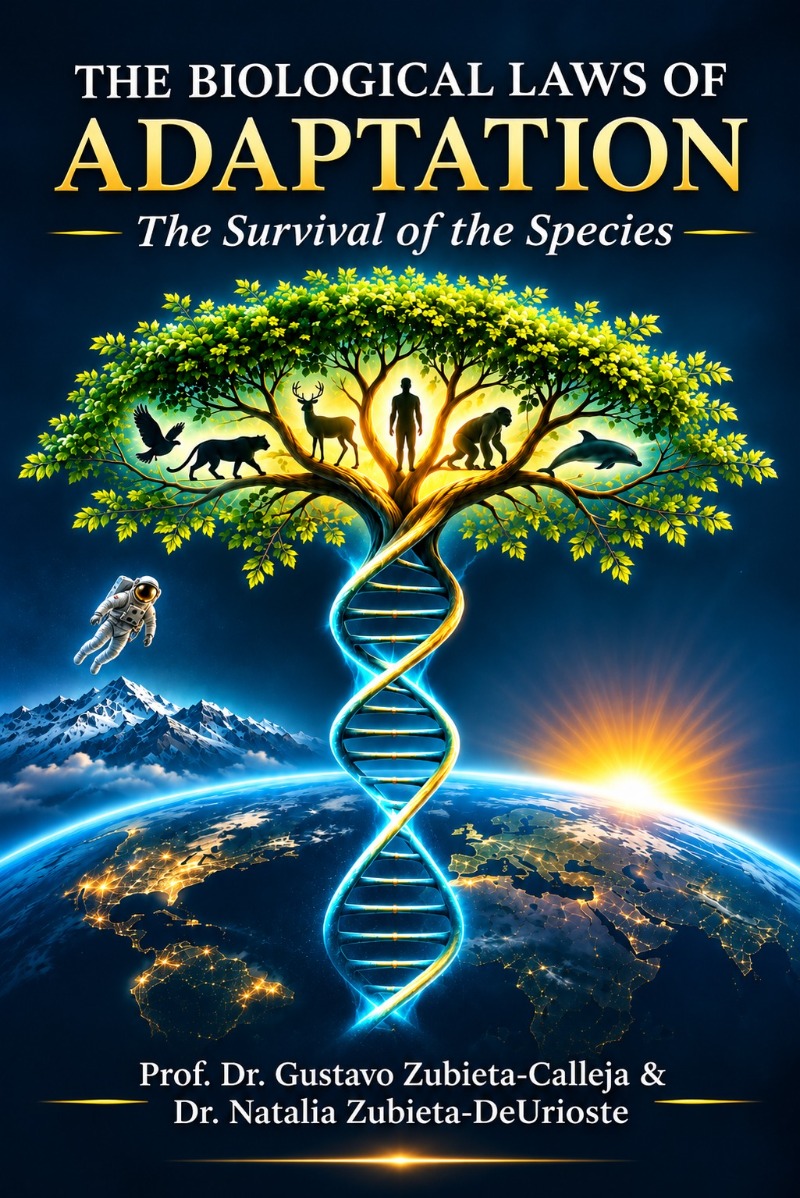
The Biological Laws of Adaptation
The Survival of the Species
| Autores: | Zubieta Calleja, Gustavo Rafael Zubieta De-Urioste, Natalia Mariela |
Materia:Ciencias de la vida Biología
Clasificación:Medicina, enfermería, veterinaria
Público objetivo:Profesional / académico
Publicado:2026-11-19
Número de edición:1
Número de páginas:0
Tamaño:16.5Mb
Soporte:Digital
Formato:Amazon Kindle (.azw)
Idioma:Inglés
Disponibilidad:Disponible
Estatus en el Catálogo:Próxima aparición
Libros relacionados
BIODIVERSIDAD NOCTURNA EN LOS CORREDORES BIOLÓGICOS URBANOS DE SACABA - Aguirre Urioste, Luis Fernando; Natalia Bellot Vargas; Katerin Carhia Tito Plata; GALARZA DE AGUIRRE, MARIA ISABEL; Peñaranda Prado, Diego Alejandro; Perez Zubieta, Jose Carlos; ANTEZANA IRIARTE, ROSSE MARY; AMPUERO SANCHEZ, FRANCY VALERIA; QUIROZ CALIZAYA, JAZMIN MAYRA; Ruiz Betancourt, Olga Jeny; Navarro Antezana, Navarro Antezana Freddy
MARIPOSAS EN SAMAIPATA - Querejazu Lewis, Roy
Educación Ambiental y Ecología
PLAN DE ACCIÓN PARA LA CONSERVACIÓN DE MAMÍFEROS CARNÍVOROS EN EL CERRO SAN PEDRO (DEPARTAMENTO DE COCHABAMBA, BOLIVIA) - Aguirre Urioste, Luis Fernando; Peñaranda Prado, Diego Alejandro; Gareca León, Edgar Esteban; Juan Carlos Huaranca Ariste; Arrazola Rivero, Silvia Susana; Ruiz Betancourt, Olga Jeny; Navarro Antezana, Navarro Antezana Freddy; Mariana Andrea Zelada Jaimes; Katerin Carhia Tito Plata; Sara Noemi Flores Equice; Natalia Bellot Vargas; Carol Andrea Almendras Gutierrez; Leinad Baldiviezo Aro; Mendieta, Paola Alba Vega; Mendieta, Yara Alexandra Cerruto Caparicon; MENDIETA ORTIZ, MICAELA
Reseña
Adaptation, the ability to adapt to any challenge and survive within a lifetime (provided the necessary conditions are met) is the most critical life-sustaining biological mechanism. Like a nonstop heartbeat, adaptation is a constant, second-by-second process that persists throughout life. While physics has advanced remarkably by elucidating physical mechanisms and developing physical laws grounded in logic, experimentation, and mathematics, biology's establishment of fundamental principles has lagged. The postulated Biological Laws of Adaptation are grounded in current knowledge, prior observations, physics, mathematics, and philosophy. Inspired by the study of physiological adaptation to high altitude, which serves as an excellent model for interpreting adaptation to any change (all events that occur as part of life itself), we propose the following eight theoretical Biological Laws of Adaptation:
1st: Adaptation is directly proportional to time and inversely proportional to change.
2nd: Adaptation maintains order by opposing entropy.
3rd: Adaptation operates under finite energetic capacity.
4th: Adaptive time scales depend on structural and regulatory capacities.
5th: Adaptive success is measured by reproductive viability and longevity.
6th: Adaptation is limited by a metabolic capacity threshold, beyond which physiological failure occurs.
7th: Adaptive pathways follow the principle of minimal energy expenditure.
8th: Loss of adaptive capacity leads to loss of systemic integrity and death.
Lifetime survival of the species, based on the Biological Laws of Adaptation, ensures that all living beings continue to exist on planet Earth and, soon, in Space through Biospaceforming.
The human organism (and all living beings) must constantly adapt to changes in environmental conditions, human interactions, exposure to toxins, trauma, and aggression from bacteria, fungi, viruses, insects, and animals throughout its lifetime. Surviving conflict, struggle, and environmental changes, such as global warming, equally requires permanent physiological adaptation. To reflect the need to adapt to modern times, this book sets a futuristic writing style. Each chapter is divided into 3 parts: the first presents the authors' original proposal and description; the second expands on this idea by presenting AI-found examples; and the third is a graphical abstract for easier digestion of the concepts. As, overall, life is intimately dependant on Adaptation.
